
This year marks the 30th anniversary of Min Tid Skal Komme by the Norwegian band Fleurety. The album is widely regarded as one of the first fully realized avant-garde black metal records and, together with releases by bands such as Ved Buens Ende, marked the beginning of a new musical language within extreme music. We asked Fleurety about their style and evolution.
By Floris Velthuis
1. Min Tid Skal Komme was released in the midst of the second wave of Norwegian black metal, yet it sounded completely different from what was common at the time.How was your music received within the black metal scene back then? Did you experience the scene as conservative, or open-minded toward experimentation? Did you see yourselves as outsiders, or as part of the black metal movement?
Yes and no and yes and no, I suppose you could say. We did have our friends who supported the music we were making, but there were also others who had their own bands and didn’t really like what we were doing. To the extent that we were unpopular, I think it had just as much to do with who was friends with whom, and it’s entirely possible that people who lived far away from us, on the west coast of Norway, for example, might have spoken highly of Fleurety if we had known them.
At the time, there was a strong urge among the black metal kids to put other bands down, and it was easier to pick on bands you didn’t know personally and whose music was quite different from your own. Everyone who spoke critically of Fleurety in fanzine interviews in the early 1990s has, without exception, been friendly and approachable when I’ve met them later in life. We understood ourselves as being closely connected to the black metal movement, but we never referred to ourselves as a black metal band. It’s also important to remember how black metal was defined in the early 1990s. Back then, the intention behind the music was what mattered, and Mercyful Fate (heavy metal), Deicide (death metal) and Blasphemy (which could be described as a form of grindcore) were classified as black metal because of their satanic lyrics. This is the Euronymous definition of black metal that many people will recognise from his interviews.
We never mentioned Satan in the lyrics we wrote, and although we took our band name from a demon in The Lesser Key of Solomon, thereby linking ourselves to what could be described as both a satanic and a Christian mythology, we never took part in any kind of devil worship. Personally, it’s probably most accurate to describe me as an atheist, since I don’t really have the ability to believe in God, the Holy Spirit, Shiva or Odin. When it comes to the musical aspect and the willingness to experiment, it has always been my view that black metal can sound like almost anything — as demonstrated by the bands I mentioned earlier. We applied the same line of thinking to our own music: as long as you mention Satan and create a musical expression that is almost missionary in its advocacy of the Devil, then it’s considered black metal. The only difference was that we didn’t care about the Satan part and instead wrote lyrics about dark figures in a more general sense.
2. Before the debut album, the EP A Darker Shade of Evil was released. More traditional, yet already clearly unconventional, especially because of the extreme vocals. How do you look back on this EP today? Was the urge to push boundaries already present at that stage? And what is true about the myth of damaged vocal cords during the recording of this release?
Last thing first: Yes, it’s true that Alexander suffered a throat injury while we were recording A Darker Shade of Evil. He has described it as a kind of snapping sensation in his throat that caused a sudden sharp pain and left him unable to sing in the same way afterwards. In the early 1990s there was a kind of antagonism between black metal and death metal, something you’ll also recognise from interviews not only with Euronymous but with other central figures in the movement, such as Darkthrone.
Death metal is often characterised by dark growling vocals, and anyone wishing to distance themselves from death metal and from the political consciousness associated with Napalm Death (I especially remember they were disliked because of releases like Harmony Corruption) could go far in the opposite direction, writing apolitical lyrics delivered in the most piercing, shrill screaming voice possible. Listen to the screaming on the track “A Lost Forgotten Sad Spirit” and you’ll immediately get a better sense of where that inspiration came from. When we pushed the high-frequency screaming even further, it was somewhat analogous to how some musicians always want to play a bit faster or use the most extreme blast beats possible.

3. With Last-Minute Lies, you took a radically different direction: clean vocals, saxophone, alienating structures, and music even further removed from black metal. How did this EP come into being, and how do you compose such music at a time when it barely existed?
We were inspired both by bands that were closer to us stylistically, such as The Third and the Mortal, and by music that was quite different from our own, like Stina Nordenstam, Anja Garbarek and Björk, all of whom have backgrounds rooted in jazz to varying degrees. We were also still in school at the time, and in our music class there were people who played saxophone, oboe and piano. Ayna B. Johansen was a year older than us and was one of the cool kids at our school that we asked to sing for us, and I remember how happy we were that she agreed to do it. I myself took piano lessons for a couple of years and wanted to learn to play Grieg, Chopin and Satie, which I actually managed not so very bad when I was at my most active.
These days, months can go by between each time I touch a keyboard (QWERTY keyboards every day, admittedly), and the little time I do have available for playing an instrument is almost entirely devoted to drums. We also listened a great deal to the Norwegian composer Arne Nordheim, a name that in Norway is most often associated with the least listener-friendly forms of contemporary music. I remember it was quite a struggle to learn to appreciate his music, but somehow it eventually worked. Some of the synth parts on Last-Minute Lies are directly inspired by Nordheim’s melodic style, even though it sounds very different from his music when we play our own songs. Nordheim also worked extensively with electronic sounds, and we drew inspiration both from that and from more popular-music-oriented artists such as GGFH, Coil, The Future Sound of London, and even The Prodigy and Nine Inch Nails. The Last-Minute Lies EP will be reissued on CD and vinyl in February 2026 by Peaceville Records along with Alexander’s project I Left The Planet, which was recorded around the same time.
4. On Department of Apocalyptic Affairs, you pushed the experimental boundaries even further, incorporating electronics, fragmentary compositions, and influences ranging from trip-hop to hip-hop. What was the artistic concept behind this album? How was it received at the time, and what music influenced you personally during that period?
I often tend to start from the idea that “experimental metal” has more or less become its own genre, with its own characteristics that are considered “experimental”, when I talk about this album. The reason for that is that the recording of Department of Apocalyptic Affairs was experimental in a way that actually relates to the original meaning of the word “experiment.” When we first entered the studio, we had a number of song sketches and several tracks that were more or less finished. But then Steinar from Arcturus stopped by the studio one of the first days to pick up some synths he had left there when they were working on La Masquerade Infernale, and Kristoffer asked him whether he would like to record a solo on one of the songs. And he did, even though he found it somewhat difficult to come up with something to play over what he described as “vulgar chords.”
This was the first time we allowed ourselves to lose control of the album we were in the process of recording, and from that point on the snowball started rolling. All the firmly held ideas I had brought with me into the studio about how the songs should be recorded and eventually sound were gradually dismantled, and the process developed into something of a kill your darlings massacre. We had made some plans in advance, such as bringing in a few guest drummers, because at that point I had lost much of my interest in playing drums and was far more focused on playing keyboards. Eventually, it almost became a sport to include as many guest musicians as possible, and as a result we ended up with something like twice as many guest artists on the album than we planned initially. The recording took place in the summer of 1998, and there was a lot of music being released at the time that we found exciting.
I remember Kristoffer and I going to a nearby record store during a break from the recording sessions, and when we came back we had picked up, among other things, Amon Tobin’s Permutation, which would go on to become one of the albums I listened to most in the years that followed. I also remember that we listened a lot to an album by the hip-hop artist Dr. Octagon while we were in the studio, and we agreed that this was far darker music than what the various black metal bands were releasing at the time. Beyond that, we listened extensively to artists from Warp Records, such as Squarepusher and Autechre. More generally, we were musically omnivorous during this period, and our listening habits were driven by a strong interest in how music is made, recorded, and worked with. That meant anything from very commercial pop like the Spice Girls or Backstreet Boys to pure noise music such as Merzbow or Masonna.
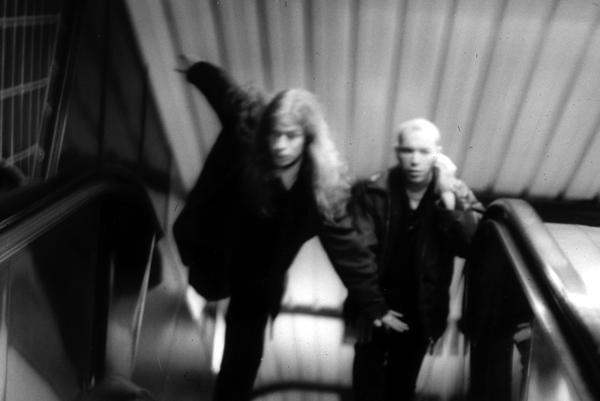
5. Between 2008 and 2017, four 7” EPs were released, later compiled as Inquietum. Why did you choose to release separate EPs instead of a single full-length album? Was the coherence between these releases planned in advance?
The shift of bands moving away from rehearsal rooms and onto the internet is a development that started something like 25 years ago, but we have never had any desire to become an internet band. We have always wanted the music, as far as possible, to happen while both of us are in the same room. That way of working is not something you get to do very often when the two members of the band live on different continents, so over the years we have recorded songs when Alexander has come to Norway to visit his parents and friends.
As a result, the songs on the seven-inches were recorded in many different places and at different times between 2004 and 2013. Ever since the first seven-inch, which was released in 2009, the plan has been for the individual singles to be collected into what became our third album, Inquietum. With that starting point, it is almost difficult to avoid giving all the releases a design that makes them logically belong together, and here I would like to give a shoutout to Trine & Kim, who have done an outstanding job with the visual expression of the various releases.
6. Inquietum is being reissued this year by Aesthetic Death — can you tell us a bit more about that?
We are probably not the only people in the world who find vinyl a bit more special than CDs, and Inquietumwas only released on CD back in 2017. Now, in 2026, it is not easy to find the four different seven-inches that were collected into Inquietum, so we decided that we wanted to make the compilation available on vinyl. When you have released music on various physical formats over the years, it’s only natural to want to release something in all the different formats. Personally, I had never released anything on ten-inch vinyl before, so it ended up becoming a double ten-inch. It’s probably a kind of bucket-list way of thinking. As I write this, the release is available for pre-order from Aesthetic Death. Just search for Inquietum and Aesthetic Death using your preferred search engine. I’m personally looking forward to seeing the finished release, which should arrive in my mailbox sometime in the coming weeks.
7. The UK-based label Aesthetic Death has released Fleurety material since the very beginning. How did this collaboration start, and what makes this relationship work so well?
It is a collaboration that goes back to the days of letter writing and tape trading, and it has been going on for more than 30 years. Stu, who is the person behind Aesthetic Death, has retained the good old underground attitude to releasing music, and cares little about whether he makes money from what he puts out. In that sense, he is probably lucky to be able to release our music, since he can be almost guaranteed that it won’t generate much in the way of financial returns. But joking aside, Stu is a truly great guy, and we are very happy that we have been able to work with him for such a long time.

8. The White Death features collaborations with various guest musicians, including Czral from Virus. Why do you work with a fixed two-piece core lineup and rotating guest musicians? How do you decide who or what fits Fleurety musically and artistically – for example, the choice to use a flute on this album?
It’s really quite simple. Cunt Krizlakh, who played flute for us on a couple of recordings, is a friend. Around 2007, he and his brother had a hip-hop project called Momrakattakk, and in that context we talked a bit about them possibly getting some electronic beats from me, since at that time I was mainly working with electronic music and releasing material under the name Zweizz. A few years later, around 2012 I think, the brothers resurfaced with a prog band called Tusmørke, in which Cunt Krizlakh played flute. We had already used saxophone, and that instrument is often associated with jazz and comes with its own set of connotations, creating certain mental images and associations for listeners. So we thought we could use a different instrument, and therefore asked him to participate on some of our tracks.
The only downside to the transverse flute is that people tend to associate it with the band Jethro Tull, because they are one of the most well-known bands to have used the flute extensively in their music. Sometimes people link our music to Jethro Tull and insist that we are inspired by Jethro Tull. Those claims are not particularly irritating in themselves, but it simply is not true that we have spent countless hours listening to Jethro Tull. It can therefore occasionally be a bit tiresome when people strongly insist that something untrue is in fact true. That has nothing to do with the flute or with Jethro Tull as such. It is simply annoying when people assert something false with conviction. But then again, we live, as I have been told, in a post-factual age. As for the fact that we are essentially a core of two people, that probably has most to do with Alexander and I being the only long-haired, black-clad youths in Ytre Enebakk when we were growing up. We had a bassist at the very beginning, but she left the band after a short time because she was not particularly dedicated.
We also had a guitarist for a period in 1992, but at that time he was also playing in Ulver. Because of the social dynamics of the black metal scene at the time, it was not considered acceptable for him to play in both bands simultaneously. A few months later, he was no longer playing in Ulver either. Shortly after that, he died, under what I understand were unclear circumstances. We played a few concerts in 1995 and 1996, and at that time we had, among others, Czral and Vicotnik from Ved Buens Ende with us as guest musicians. After 1996 we had little desire to perform live, and since then we have operated as a duo with guest musicians in the studio. When Czral appeared on The White Death, which we recorded in 2014, that was a continuation of something we had been doing for many years. He had also been involved on Department of Apocalyptic Affairs and on the Zweizz and Joey Hopkins album, on a vocal recording I made at home around 2009. When we recorded The White Death, we had decided to keep the number of guest musicians to a minimum. That meant flute, one male guest vocalist, and one female vocalist, Linn Nystadnes from Deathcrush. The reason for that was that I had seen Deathcrush many times and felt that Linn had a certain coolness that I hoped would also benefit Fleurety.

9. Many avant-garde bands use alternative guitar tunings to create dissonance. Do you use alternative tunings as well, or does the atmosphere mainly come from composition and arrangement?
Alexander is the one who plays guitar in the band, and he has never seemed particularly interested in alternative guitar tunings. I have also never prioritised that as something I should push for us to do in Fleurety. In any case, I would not have any guitar riffs that would justify tuning to drop D or whatever it is called, since I almost never write guitar riffs. The fact that you are asking this question now could probably be taken as an argument that we manage just fine without alternative guitar tunings.
10. What can we expect from Fleurety in the future?
Apart from the Inquietum and Last-Minute Lies reissues, there will also be some t-shirts and hoodies with Min Tid Skal Komme prints available fairly soon. The merchandise can be ordered from Aesthetic Death, just like the Inquietum vinyl. We also have a couple of new songs that we have written, and they are at different sketch-stage levels. Some could be recorded tomorrow, others need guitar arrangements, and still others are loose riffs that need to be placed into a song context. We have more or less reached the end of the material we have available for reissues, so there will probably not be much more of that in the near future. Min Tid Skal Kommehas now been reissued three times, first in 2003, then in 2009, and finally in 2019, and it is not impossible that it could be released once again. It is not for our own sake that the album keeps being reissued, but rather to make it available to those who might want to own a copy. The main project going forward is to complete a new album, but we have always been a slowly working band, so it is difficult to say when we will be ready to release something new.
11. Thank you for your time and for the music. Do you have any final words for the readers?
Thanks for your questions, and thanks to those who have read this far. I would also like to mention another band I have, called Meta Dage. This is a strange little project where we play Norwegian versions of artists such as Venom, Samantha Fox, Bathory, Billy Idol, and Dead Kennedys. The versions can certainly be said to be quite far removed from the originals. We are happy to welcome new followers on Instagram if anyone would like to keep up with what is coming from that direction: instagram.com/meta_dage/
Fleurety:
Instagram
Facebook
Labels:
Peaceville
Aesthetic Death