

There’s something I like about the fact that a record called Cosmic VVampiric Rites of the Post-Humanian Ascent Sequence exists as a tiny lathe-cut edition with a handmade sleeve. Spend five minutes on Oscillascura’s Bandcamp page and you’ll see what I mean. Even finding out who plays drums takes a bit of decoding. Somewhere in Salt Lake City, though, someone had to sit down and make those sleeves.
B.T., the man behind Oscillascura, calls his music “posthumanistic blackwave”. To my ears there’s a good deal of Dungeon Synth in there, and what surprised me most were the Black Metal vocals. There’s a real bite to his delivery that cuts straight through the electronics. When I reviewed the album, I kept coming back to a phrase B.T. had used on an earlier release, Vitrification. The songs were made with “algorithmic assistance”. I wanted to know what that actually meant. What does B.T. play himself, what does he leave to the software, and what happens when he takes the whole thing on stage with a live drummer? Time to put a few questions to the man himself.
1. Oscillascura began as a solo project in 2020. What prompted you to start it, and what was your musical background at the time? What did you want to explore through this project that you hadn’t previously had room for?
I was a self-taught bass player in a band from 2003 to 2005. I wrote and sang my own lyrics, but I didn’t write the music. After that, I didn’t do anything musical until I started Oscillascura in 2020.
Perturbator’s The Uncanny Valley got me into Dark Synthwave in 2016. From there, I began listening to Gost, Occams Laser, and Carpenter Brut. I kept reading about Dark Synthwave’s similarities to Black Metal, but most of what I recognized was in the imagery. I wanted to hear what would happen if you wrote a second-wave Norwegian Black Metal song using dark synth sounds. Then Gost released Possessor in 2018. I heard the blast beats and Black Metal vocals and thought, “Dang, this dude beat me to it.” However, that record sounds more like a Dark Synthwave album with a few Black Metal compositional elements included. It was still inspirational and motivating to hear.
I do not consider myself to be a trained musician, but rather a tourist in the space. I have a master’s degree in design with an emphasis on interaction design, human-computer interaction, and research, and I’ve worked in tech as an interaction designer for more than a decade. A lot of that work involves doing ethnographic research on people who know a field inside out, understanding how they do their work, and designing prototypes and interfaces around what you learn. I approached Black Metal composition by using familiar design and research methods. I watched hours of tutorials, read guitar tabs, and diagrammed how musicians built riffs and moved from one section to the next. I wanted to know why a riff ended on a particular note and where it could go from there. Exploring music theory, like the circle of fifths, gave me a way to explore that question when “just play what feels right” didn’t give me much to work with, especially since I do not play guitar.
At the same time, I was learning sound design with a synthesizer and programming drums, which was harder than I expected. I spent two years of discovery doing all of that in my spare time. The first six songs I finished became my first album, Vitrification.
2. You use the term ‘Post-humanistic Blackwave’. What does Blackwave mean to you as a musician, and which records or artists helped you discover this combination of Black Metal and electronic music?
My first encounter with the term Blackwave was while listening to Striborg. He has an album called Black Wave, and it’s a pretty interesting listen. He certainly has pioneered the genre. His definition of Blackwave combines ’80s Synth-Pop with Darkwave and the atmosphere of Black Metal. I also use ’80s synth elements, and on my first two releases I use ’80s-sounding drum machine toms blended into my electronic kit. My interpretation of Blackwave is more aggressive, and I wear my Darkthrone influence on my sleeve. I introduced the “Post-humanistic” label to help try and describe what the music is all about. I started with the label “Transhumanistic Blackwave,” but decided to change it to “Post-humanistic” as a way to not pigeonhole myself into Transhumanism exclusively.
I borrowed the label “Black Metal Electronica” from Siliniez, who I consider a peer in the genre. He has two electronic Black Metal projects based in Australia named Opium Grave and Ouroboric Deity. He started in 2016 and describes his music as “Black Kosmische Musik”. It mixes more ’70s and ’80s analog synth sounds with elements of Black Metal and Post-Punk. He has supported both my album releases and described Vitrification as “A true manifestation of black metal electronica.” I cannot express how supported I felt or how meaningful my efforts felt after I received that message from him. I hope he doesn’t mind that I shared that.
I also love how seamlessly Dragged Into Sunlight and Gnaw Their Tongues fuse Extreme Metal and Power Electronics on N.V. I wanted the synths and Black Metal in Oscillascura to feel that integrated.
Gregorio Franco, out of Atlanta, gave me a direction and the motivation to try it. I think he’s a genius. He’s made everything from Dungeon Synth and Chiptune to Doom Metal. His EP Shadow of the Wake is melodic electronic Black Metal and a must-listen if you’re a fan of Dissection. And his album Judgement is a cosmic electronic Death Metal masterpiece.
My favorite track on Judgement is “Inherited Fate.” About 1:22 in, there’s this incredibly fast Chiptune sequence over blast beats. I remember thinking, “That’s how I could do tremolo picking with a synth.” He released the stems for people to remix, and I took a shot at it. I didn’t have the chops to make a decent remix yet, but I could hear each layer on its own and see how they all fit together. That taught me a lot about how to build my own songs.
3. To my ears, Dungeon Synth plays an important role in your music. The genre is often associated with the distant past and fantasy worlds, while Oscillascura looks towards the future. What draws you to that combination?
I’m a Dungeon Synth fan, though it wasn’t a big influence on how I wrote the music. I was drawing more from Cyberpunk and Outrun Synthwave. I can see the connection in the atmosphere and the way both deal in fantastic ideas. I mean, I put a pipe organ on an album about cybernetic vampires flying through space in a castle, so I can see where you’d hear it.
4. The title Cosmic VVampiric Rites of the Post-Humanian Ascent Sequence brings together vampirism, ritual and a posthuman existence. Could you take us through the story behind the album? What exactly is being transformed, and at what cost?
I listen to a lot of vampire-themed Raw Black Metal projects. I wanted to make a vampiric record that fit with the themes of transhumanism and thought incorporating energy vampirism would work well. Vampires and transhumanists both got me thinking about what you’d have to depend on to live forever. We already drain the planet’s resources to keep our systems running. I took that a step further and imagined people modifying their bodies until they needed only electric systems of consumption just to stay alive.
By the time the story begins, humanity has drained Earth of its usable energy. A few survivors build a castle-shaped spaceship and head out looking for another power source, or a planet where they can start the whole cycle over again. They’ve escaped some of the limits of being human, but now they can’t live without the systems they built. I wrote the story in eight paragraphs, one for each song. I turned it into a kind of digital illuminated manuscript written in a command-line terminal, which appears on the record insert and in the album’s terminal archive.
5. The tracks have subtitles such as ‘Initiation’, ‘Error’ and ‘Arrival’. Do these represent different stages in a single process? How did that story shape the album’s running order and musical structure?
Yeah. The song titles reflect what’s happening in the story, and the words in brackets are commands or system messages that mark each stage. Getting the story to fit on vinyl meant working with about 20 minutes per side. I moved some songs around, cut “Drift Beyond [Calculation]” from nearly eight minutes to four, and wrote “Solar Extraction [Redirect]” to fill out the B-side. “Belief Command [Override]” was supposed to close the album, but I brought in “Obsidian Throne [Arrival],” which I’d been saving for a companion EP. I started out planning six songs and ended up with eight.
The track order follows the story, but musically the album is my love letter to the ’90s Norwegian Black Metal scene. I took a lot of cues from the way Darkthrone structured the songs on Transilvanian Hunger. I can’t tell you how many times I’ve listened to the special edition with Fenriz’s commentary. There are little nods and Easter eggs to some of my favorite records from the Norwegian scene throughout the album, and a few are pretty on the nose. The opening riff on “Post-Humanian [Slumber]” is criminally close to the one on “Transilvanian Hunger.”
Almost every song is at either 140 or 148 BPM. I originally wanted to stick with the same repetitive blast-beat pattern, but halfway through I felt like I was writing the same song over and over. I also knew we’d be playing these songs live, and I wanted to give KJT more to work with. So I started changing up the drum patterns. I hope anyone who loves that era of Norwegian Black Metal can nerd out a little and catch some of the Easter eggs.
6. What personally appeals to you about transhumanism? Do you mainly see overcoming our physical limitations as an opportunity, or does the idea also frighten you? Which of those feelings comes through most strongly in your lyrics?
I am not a practicing transhumanist, but I am interested in observing human/computer behavior, especially when it comes to cult-like behaviors. It’s unfortunate that transhumanist ideology is spearheaded by technocratic sociopath billionaires who (most likely) do not have people’s best interests in mind. I’d like to be optimistic that the ideas can advance humanity in a positive way, but I am skeptical.
I’m fascinated by what people are willing to believe if you promise them immortality. Transhumanism gives me a way to write about belief, individualism, and skepticism within the world of technology. I’ve spent much of my design career working in science and medical technology, so it felt like familiar ground to write from.
Cognitive transference is one of my favorite ideas. Imagine sending your consciousness into space on a computer and printing yourself a body when you get to your destination. I love that idea because it seems to make sense for space travel. Then I get stuck on what happens at the moment of upload. Do you wake up in the computer, or does a copy wake up while you’re still in the body you thought you’d left behind?
My fears and unease probably come through most strongly on my song “Heretical Mechanism” on Symbiosis Ex Machina. The lyrics take it in a more extreme direction. It’s about a humanoid robot army taking over and tearing down humanity’s institutions of religion and government.
7. One thing that pleasantly surprised me was how convincing the Black Metal vocals sound among all the electronics. How did you develop that voice, and what determines when you use it? When you sing, are you taking on a character within the story, or is it a deeply personal outlet?
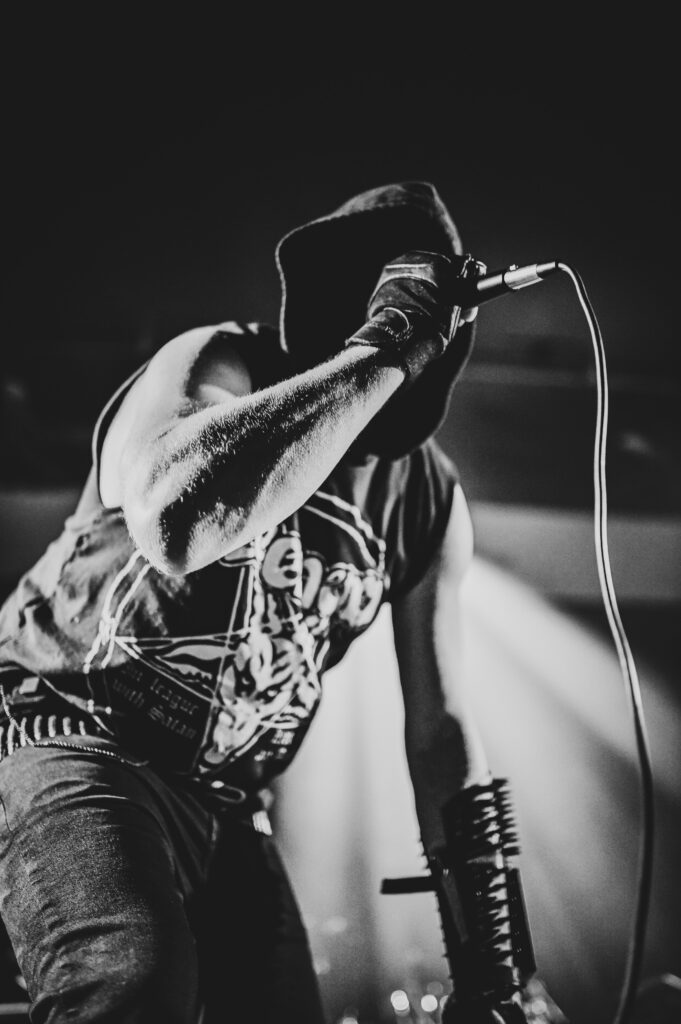
I appreciate that, because I’ve never thought of myself as a particularly strong vocalist. Tomas Lindberg is a big influence on my vocal style. I try to get that aggressive, higher-pitched fry while keeping the words clear enough to make out.
My first test of music and vocals was a 2:20 cover of Darkthrone’s “En Vind Av Sorg” using stock GarageBand sounds. I sent it to my Black Metal guru, Mykee, who said it was strange to hear that style without guitars but that the vocals and music sounded unique. I trusted his ear. He gave me recording advice. I also received vocal advice from Dusty, the singer in an exceptional Heavy Metal band named Airacobra. His advice helped me learn how to sing without hurting my voice. On recordings, I use a fair amount of reverb and a little bit of a fuzz effect.
A lot of the Electronic Metal I was listening to was instrumental. I wanted my voice to give Oscillascura its own sound by bringing something human into the electronics. I usually find the vocal phrasing by humming over the finished instrumental and then write words to fit it.
Since you bring up having a character within the story, here’s a little Oscillascura scoop I’ve only shared with one friend. On Vitrification and Symbiosis Ex Machina, I wrote the lyrics and sang from the perspective of an AI cult leader I called the Forbidden Algorithm. It’s selling humanity on cybernetics and convincing us to hand the world over to computers. It unleashes the “Kill Code” in the first track of CVVROTPAS. From there, I’m mostly narrating the story.
8. Could you walk us through the creation of one track, from the first idea to the finished recording? Which parts do you perform yourself, which do you program, and how do you put together the drums, for example?
I program everything as MIDI in Ableton Live Lite. It gives me 16 tracks, and I like working within those constraints. My “guitars” are three layered Reese bass patches I designed in Serum VST. I use them the way a Metal band might layer rhythm and lead guitars. For tremolo picking, I use a separate bass patch with a short envelope so it sounds plucked. I reserve the other tracks for the leads, sidechains, pads, and organs.
Sometimes I start by programming drum loops and trying riffs against them. I usually arrange the song in four-bar sections and move them around until the transitions feel right. That’s the part that feels most like design to me. My goal with composing a song and album as a whole is to have a balance of unifying elements and to add some variety to keep it interesting.
A riff can repeat enough to feel familiar, and then a short transition or arpeggio can break up the pattern. I save the drum fills for later and usually give each song one or two of its own.
Once the instrumental is ready, I export an MP3 and listen to it in my truck or before bed. I hum vocal ideas, record them on my phone, and write lyrics that fit the syllables and inflections. I’m a sucker for a good chorus. Then I record the vocals in GarageBand, mix and master the track, and send it to a few trusted friends for feedback. I listen to my own music pretty regularly. I can compartmentalize that it’s me singing and just enjoy it like it’s a band I like.
As for the production, I did experiment with ways to make it sound like a raw/necro production style. I use minimal equipment and try to maximize what I make with what I have. I could add lo-fi and analog effects, and I have tried that. I even have an instrumental mix of Vitrification where the music was run through an analog compressor. But instead, I opted to find my own version of “Necro” production and wrote my own set of principles to follow. I’ll keep those to myself, but I try to not overprocess the patches/presets. And I won’t overuse the effects.
My single, “Enhanced Capabilities” was created start to finish in one night of work. I wanted to challenge myself to see if I could follow my principles and it worked out. I was slightly inebriated and accidently deleted my vocal track and could not recover it. The vocals on the song are my first take and unpolished. So the song is what it is. I eventually had to write the lyrics down so we could play it live. I had to decipher what exactly I was singing about. Ha, that was more difficult to do than write the music.
9. On Vitrification, you state that the songs were created with ‘algorithmic assistance’. What specific techniques does that refer to, and do you also use them on the new album? Could you clarify whether generative AI is involved and, if so, what role it plays?
Sure. I was trying to be clever and cryptic when I wrote that. Machine learning models can be described as advanced algorithmic systems, but there’s a technical distinction between a learning algorithm and a learned model. An algorithm is a defined sequence of instructions or operations designed to accomplish a task. There is no minimum level of complexity required for something to qualify as an algorithm.
For Vitrification, I wrote a simple function that generated random sequences of numbers. I’d map those numbers to notes, try them in different keys and scales, and put them into a MIDI track. I got some really wild-sounding melodies that way. I liked the idea of taking something computational and giving it a voice in the real world. It felt like searching for a diamond in the rough. If a sequence caught my ear, I’d use Ableton’s scale view to see which notes fit and adjust them until the melody sounded like it belonged. Sometimes I liked the dissonance enough to leave it in.
“New Life” was the first song I wrote, and the opening tremolo-picking riff came from one of those sequences. It’s a little bananas. I wasn’t sure it made musical sense, but I liked the way it sounded and designed the rest of the song around it. I used that approach on Vitrification and Symbiosis Ex Machina. By the time I wrote Cosmic VVampiric Rites of the Post-Humanian Ascent Sequence, I’d moved away from it. Instead of random numeric sequences as a starting point for riffs I started with a base note and moved the following notes up and down the scale by intervals of 2-3-5-7. There were a few happy accidents on some songs that again I wasn’t sure made sense musically, but seemed to fit. An example would be the descending organ chords on Drift Beyond [Calculation]. I was listening to that section on a loop and thought they sounded cool. I also learned more about arpeggiations and used them more frequently.
The music itself didn’t use generative AI. In 2022, I used it for some artwork when the technology seemed more primitive. I’d seen people in the vinyl collecting community on Instagram enter Death Metal and Black Metal lyrics and titles into image generators, and most of the results looked like psychotic fever dreams. I wish this were still the case for generative images. I was intrigued for the same reason I liked the numerical sequences. I wanted to see what a computer would do with the input. However, I can relate to the present-day backlash against AI “slop.” It’s very annoying to have it pushed down our throats. Around half or more of Internet traffic comes from bots, while AI-generated “slop” makes up roughly 10% to 50%+ of web content, depending on how it is measured and filtered. And I used an AI-driven query to get those stats. Do you trust it? What the hell are we doing here?
The image used on the insert in the cassette and lathe-cut editions of Vitrification came from feeding lyrics from my song “Cryonic Suspension” into an image generator. It made this pile of machinery and flesh with half a human skull at the top of the composition and gave it way too many teeth. The placement of the skull is not what an artist would do intentionally in a composition. I actually love that image. I just want to know why the generator made the “choices.” I’ve since made T-shirts with it. I also used some of those images on instrumental cassettes I gave to friends, and as backgrounds for a few YouTube videos.
10. Where do you draw the line between a tool and a co-writer? When software produces an unexpected musical result, how do you decide whether it belongs in Oscillascura? Have you rejected material that worked technically but expressed nothing to you?
With the numerical sequences, I treated the randomizer as a tool. It could give me a starting point. I decided what to keep, what to change, and whether there was a song in it. I rejected hundreds of sequences. Ableton could show me which notes fit the scale, but hearing them in context was what mattered. Sometimes the weird note was the whole reason I liked the riff.
11. Your presentation is full of code and system messages. For some listeners, that adds to the atmosphere; for others, it makes the information difficult to access. How do you decide what to keep obscure and what to explain clearly about the music and the people behind it?
It’s a tough question. I have a lot of fun writing in that glitchy syntax, but if I wrote every show announcement and liner note that way, things would get confusing pretty quickly. I’m still trying to figure out a balance between the expressive syntax and how I want to communicate. Personally, I’m a relaxed, informal communicator. There’s a formality to the way some Oscillascura artwork and messages are written. I try to balance that with being clear when people need practical information, like when and where we’re playing.
I want to leave some mystery around the story and the lyrics. Keeping the lyrics private gives people room to interpret the songs for themselves. The Forbidden Algorithm is a good example. I’d kept that idea mostly to myself before this interview, and people could still make sense of the music in their own way.
One of the most satisfying things I can imagine is somebody stumbling onto Oscillascura and having it become their favorite thing for a little while. It becomes theirs. Maybe they keep it to themselves, or maybe they send it to a friend and say, “You’ve gotta hear this weird shit I just found. It’s actually pretty good.”
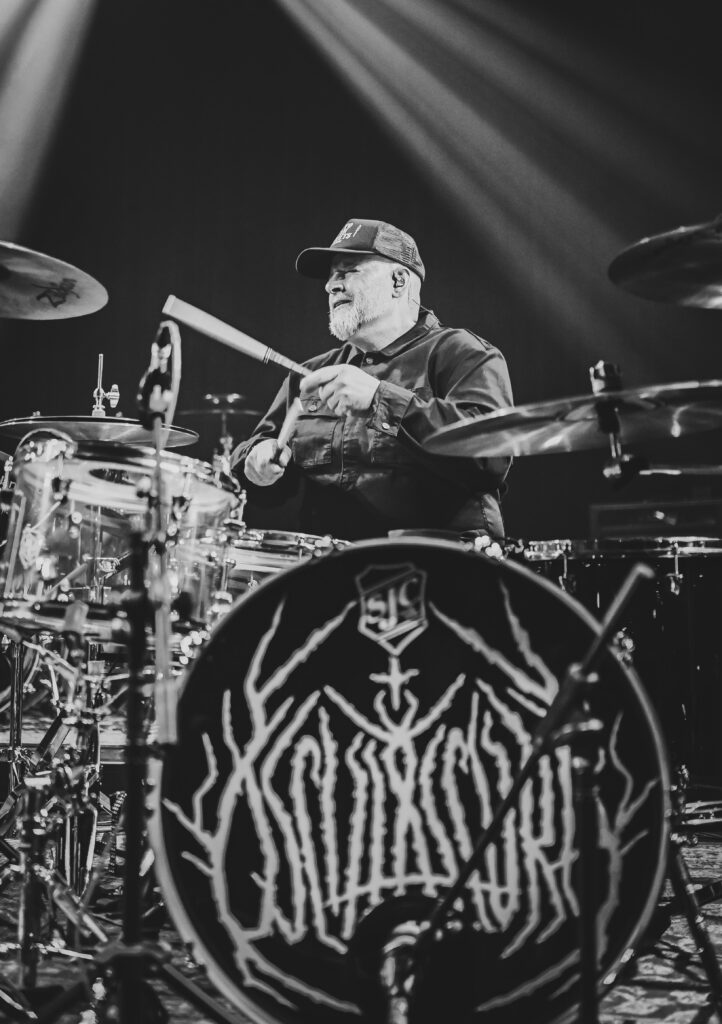
12. You work with other musicians for live performances, including drummer KJT. How do the songs change when you perform them together on stage? How much room is there for their own interpretations, and do you bring any of that back into the studio?
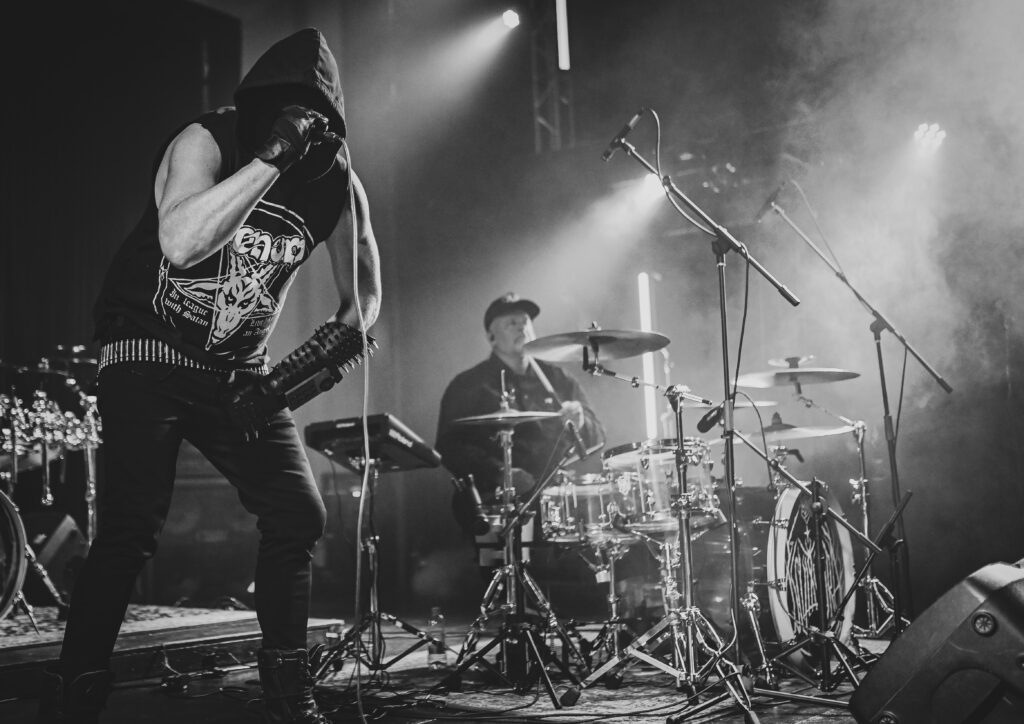
BT: I never thought I’d play these songs live. Even though I’d been in a band before, I still get pretty serious stage fright. I’ve known KJT for more than 20 years and really respect him as a musician, so I asked him to help me figure out how to do it. He suggested looking at what other bands like mine do. I looked at Master Boot Record, who have live guitar and drums alongside a computer handling the synth parts.
That gave me the idea that my computer could be my guitar player. I take the drums and vocals out of the studio tracks so KJT can play the drums live and I can sing over the rest. The Reese bass parts that stand in for guitars go through my bass amp stack onstage, and the rest goes through the house PA.
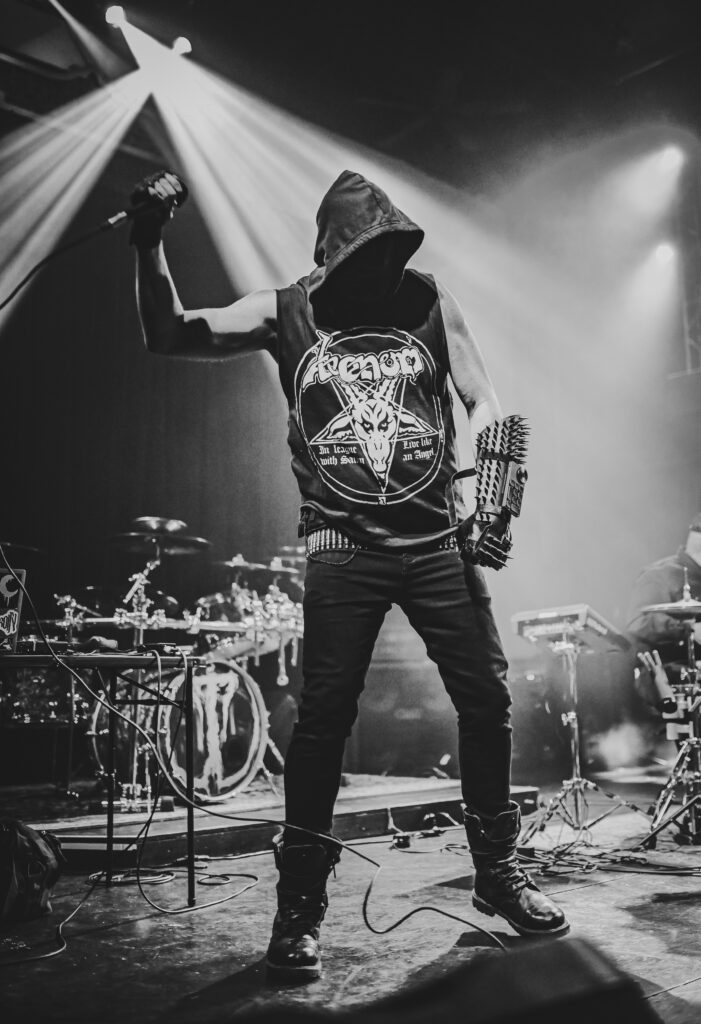
At our first couple of shows, I used a little Korg pad to trigger the songs. I had to walk back over to it between songs, which broke the flow. That’s where the Power Gauntlet idea came from. I grew up in the ’80s and always thought the Nintendo Power Glove looked incredible, even though I never owned one. The Power Gauntlet has a Bluetooth shortcut controller that lets me trigger songs from anywhere onstage. I even mapped pitch shifting to the little wheel, but after trying it at a show, I could barely hear the difference, and it was awkward to use mid-song.
I’ll hand it over to KJT to talk about how he makes the drum parts his own and what we might bring back into the studio.
KJT: Once we’ve stripped the electronic drums and vocals from the recorded tracks, we add a click track that goes to our in-ear monitors. I map out the drum parts and changes in each song, then send my notes to BT. He adds cues before each section to remind me what beat to play, where the fills are, and when to stop. Onstage, he runs the bass signal through a bass head into two 4×10 cabinets, and the higher-frequency parts go through the house PA.
When we first started playing together, those cue tracks could get pretty complicated. As we’ve gotten more comfortable playing together and more familiar with the songs, we’ve pared them down a bit. I think the approach fits the project’s transhumanist themes. It feels almost like I’m programmed to play certain parts and trying to execute commands as they come through my in-ears.
As far as my own interpretations go, I’m human and can only do so much, haha. I do my best to mimic the electronic drums on the recordings, but sometimes I’ll cheat a bit or make a part my own to give it a more human feel. I also use kick and snare triggers with samples from previous records to keep those electronic sounds in the live mix. We throw in some noise tracks and samples during and between songs to add to the atmosphere.
On the last record, BT invited me to do some drum programming, but I like the challenge of playing parts written by someone who doesn’t approach them as a drummer. Trying to mimic what’s on the recording pushes me out of my comfort zone. I did give him a few production notes before the album was finished. They were small tweaks I thought would enhance the songs, and I wanted to keep what made the parts challenging to play.
We’ve released some live and rehearsal recordings if anyone wants to hear how the songs change when we play them. We’ve also talked about going back into the studio after each album to record a handful of songs with live drums, along with covers of bands or projects that influenced the record. It would be a kind of Redux EP between albums.
13. The album also received a very limited lathe-cut edition with a completely DIY sleeve. How did that release come together, and how much work went into making the packaging? What appeals to you about such a small, handmade run, and what place does that physical craft have alongside your largely digital music?
I’m a physical media nerd, so I wanted to make something I’d be excited to find as a collector. I fund the physical releases myself, with help from whatever I make from digital sales and shows. For all my vinyl, I worked with a lathe-cutting shop called Little Elephant. They only cut the lathe records. I make all the rest of the packages. I screenprinted the fold-out sleeve at home. I hand cut and glued the OBI strip, a color insert, and a mini poster.
In a past life, I was a graphic designer making publications, books, T-shirts, snowboards, and all sorts of other physical things. I don’t get to use those skills as much in my day job, so Oscillascura is a good place to do it. I undercharge what it costs for me to make one unit so I usually do not break even. I remember being nervous about spending around $500 on the first Vitrification lathe cuts. A friend who collects records told me to just do it. He said the people who got a copy would cherish it. That’s how I feel about small runs I’ve bought myself, and I hope people feel the same about mine.
I’m also fascinated by the lathe cutting technology itself. Rob at Little Elephant has a video where he walks through the process, and I remember being impressed that his setup could cut in stereo. I have to prepare a different master for vinyl, so it’s a different listening experience from the digital release. The lathe can add some surface noise that I feel adds to the atmosphere of the music. Cassette tapes add noise and flutter, which gives the music another character. That fits with what I enjoy about Raw Black Metal production and cassette demo culture.
The cassettes for CVVROTPAS was my first time working with a record label. Oscillascura is still pretty far underground, and I understood that a vinyl pressing would be a big investment for a project with a small audience. Cassettes made sense for both of us. By the time I approached Vinyl Hex Records with CVVROTPAS, I’d already mocked up the cover and cassette J-card and placed my lathe-cut order.
Vinyl Hex’s first two releases were a vinyl collector’s dream. The pressings looked spectacular, and the professionally printed jackets and inserts made the whole package feel special. I wanted our cassette to live up to that, so I pitched two editions. I’d dub the green Plasma River tapes myself, and Vinyl Hex would put out the blue Energy Vampire edition with professionally duplicated tapes and printed J-cards. Each edition would get its own color-matched OBI strip. I hand-cut, folded, and glued all 50 OBIs for the Vinyl Hex edition. Packing them up and mailing them to Budapest was nerve-racking. I threw in a few extras and hoped they’d all get there in one piece.
What I appreciated most was how open Vinyl Hex was to my ideas. I got to keep the DIY side of Oscillascura in a professionally produced release, right down to folding and gluing those OBIs by hand. That meant a lot to me, and I love working with them.
14. How has Oscillascura been received in and around Salt Lake City? Do you feel connected to the local Metal scene, to electronic acts, or to both? Has an audience reaction ever changed the way you see the project?
Thank you for asking! I love this question because I get to shine a light on the Salt Lake City underground. I feel most connected to the local Metal and Punk scenes. When I moved here in 2001, Burt’s Tiki Lounge was my go-to spot to see local and touring bands. You could walk in and see a show for free. I got introduced to local Punk through Endless Struggle and P.O.A. (Pissed on Arrival) while going to Burt’s. My introduction to the Black Metal scene in SLC was through Ibex Throne, the Pagan Dead, and Yaotl Mictlan.
The Pagan Dead is a Psychobilly band that mixes Pagan Black Metal and Rockabilly. You’ll never hear anything quite like it. Yaotl Mictlan were doing their own take on Indigenous Black Metal many years before it was a trend. Salt Lake City is also the home of one of the best traditional Heavy Metal bands you’ll ever hear, Visigoth! It’s also home to two underground Black Metal darlings, Caladan Brood and Gallowbraid (who also recently started playing live). Oscillascura is not the only synth driven Heavy Metal here. The band LAST is a punishing drum and synth Doom Metal duo. Hearing bands like that made me feel like Salt Lake has room for experimentation in heavy music.
Burt’s eventually closed, and Aces High Saloon is now the home for Salt Lake’s Punk and Metal underground. It’s a one-of-a-kind Heavy Metal-themed bar and grill. That’s where we’ve played most often. The Grave Shift Press booked our first show there at the end of a Heavy Metal marketplace. We got a 40 minute set and played most of Vitrification, all of Symbiosis Ex Machina, and our cover of Darkthrone’s “En Vind Av Sorg.” Getting to play with Wicked Temple (which is a seriously talented Beatdown Thrash band) and Substained, an extremely dark and talented Black Metal band I admire a lot, was already a dream for me. Then we opened with “New Life” and watched people start to gather. There were people up front headbanging and shouting with us, and others were dancing to songs like “Human Condition.” I never expected that kind of response. KJT and I still talk about how much fun that first show was. Seeing people respond in such different ways made me feel like the music could work live.
We also played our first festival, Prikfest, this past summer. It still blows my mind that there are enough underground Metal and Punk bands here to fill three days. And I have to shout out bands we’ve played shows with: Acid Hologram, Wicked Temple, Death Persona, Tryygon, Contraferris, and The Mutiny. I discover more bands every time we play.
15. Where would you like to take Oscillascura next? Are there musical ideas or collaborations you have deliberately put off so far, and what would you like to attempt on a future record that you haven’t yet mastered?
The next release I’m working on is a two-song release on 7-inch vinyl and cassette. I already have the lathe cuts and tapes in hand, and I’m still working out the artwork. I’d like to possibly draw the cover by hand. But maybe I’ll have to go back to using photos. One song is a very fast, Immortal-inspired track. The other is “Astral Devotion [Depart],” a Goth Rock song with piano throughout that we’ve already played live. Both songs take some mild inspiration from the anime Vampire Hunter D: Bloodlust, but they take place in the same world as my energy vampire story.
I originally had four records in mind. Vitrification was the experiment to see if I could make Black Metal Electronica. I planned to follow it with something faster and heavier with industrial elements, then a love letter to Transilvanian Hunger and second-wave Black Metal. The songs I was writing felt closer to that third idea, so I moved it up and made it the second album. I still want to make an industrial record, and I’d like to try a midtempo record with some DSBM elements.
I’m also experimenting with more of a Computer Metal sound and co-writing a song with Ramera, a Speed Metal artist from Colombia. KJT wants to cover “Mess of Wires” by METZ. Maybe those songs could turn into an EP. We’ve been talking about writing together and recording his drums in a studio, which would give us a chance to build songs including his playing. I’d also like to play a show outside Utah and work with Vinyl Hex Records again.
A lot of what’s moved Oscillascura forward has been saying yes to things that make me uncomfortable. I recently did an Instagram video with Odin Conquers All. In these videos, a Heavy Metal dad named Adam introduces his son Odin to different Metal bands. I was hesitant to do it. As of today, the video has 17,000 views. That many people have seen me talk about Blackwave and transhumanism. It’s hard for me to fathom that kind of reach. The experience reminded me of the book The Surrender Experiment and how far you can end up from where you started just by saying yes to a few things.
That applies to this interview, too. I appreciate how much thought you put into the questions. They made me sit down and think about what I’ve done with the project and where I want it to go. Thank you very much!
[B]01000010 [T]01010100
:: /VOCAL.HEX{PRIMAL_VOICEX}
:: OUTPUT>>INVOKE_WRAITH_CHANNEL
——
[K]01001011 [J]01001010 [T]01010100
:: /EXECUTE.MOD{LIVE_DRUMS}
:: SIGNAL>>PERCUSSIVE_PROTOCOL
——
MODEL: [CXXVHX43HTDD]
:: /SYNTH.LIVE{NEURAL_SYNTHESIS}
:: TRANSMIT>>VOID_HARMONICS
Live photo’s by Sarah Clark Instagram