
I recently became acquainted with the new French band Horion through Void Wanderer Productions. With the EP “Doom,” the band presents its first offering… and what a statement it is! What immediately stands out is that their style resists easy categorization: experimental, unique, and performed with palpable intent and dedication. My interest was instantly sparked, and I am therefore delighted to interview Horion.
Could you introduce Horion? How did the band come into being, and what was the original necessity or driving force behind this project? What does the name “Horion” mean, and how does it relate to your music?
Hi Floris, thank you for your time and interest in Horion! To introduce the band, it was simply born from a common desire to create something direct, melodic, driven by a simple will: be unique. We are not gatekeepers, and we desire to craft our own path.
The band started with two members, Tony (drums) and Jej (guitar / vocals). Then they quickly found Priam (cello) via a local online group. At first he was interested in the bass guitar job, but he also said “guys, originally I’m a cello player”. We immediately felt the potential and answered “nevermind the bass, bring your cello instead!“. Guillaume (lead guitar) and Eric (bass guitar) were good friends, and also had a band together at high school. So we decided to let them in to extend our forces. Friendship is really important to us, it’s a constant key to move forward in the same direction.
About Horion’s name: it’s an old French word meaning “a violent beating given to someone“. Short and efficient.
“Doom” is an impressive debut. Why did you choose this title? Is “Doom” a thematic concept, an emotional state, or something else?
Doom can be many things. It’s basically fate or fatality. We consider both aspects. Emotions are driven by this. Like the band’s name, the EP title is simple and full of meanings.
The EP hit me like a sledgehammer. I was struck by the melting pot of influences and styles. I hear elements of death, black, and doom metal, but also an intensity and anger that reminds me of old-school hardcore and punk. Which musical (and perhaps non-musical) influences have shaped Horion?
All of us are metal listeners, but not exclusively. Black and death metal are obviously a strong core and link between us, but we all listen to a lot of different other genres (classical, alternative & experimental music…etc).
It’s impossible to give you a top 3 or 5 bands that influenced Horion, but it’s a great mix of artists we appreciate, like DeathSpell Omega, Dissection, Drudkh, Pénitence Onirique, Tangerine Dreams, The Faceless, Necrophagist, Cult of Luna, Neurosis, Death… and many more.
We also appreciate a direct and efficient approach in songwriting, with a strong influence from the old school scene.
Your EP is being released through a black metal label, yet Horion clearly encompasses more than just black metal. Do you see yourselves as part of a specific movement, or do you consciously try to remain outside genre boundaries?
We enjoy playing music we have never heard before, we want to build and shape our identity. People will always try to find common tones and affiliations with other artists, but our goal is to create something singular. In our local scene, we are out of bounds. We’re surrounded by hardcore and punk bands. Extreme metal is not the first genre people listen to here, and we don’t want to force us to play what people want to hear. Even if we sometimes have a hard time finding live gigs around here.
We don’t care about categorizing our music, that’s why reviews and listeners exist, to place you in a box! Maybe some kind of blackened death progressive music? Or maybe not, that’s not really important for us.
One thing is sure: being out of bounds isn’t easy all the time, but in the end we’re honest and we play our music 100% with our guts.
Despite its remarkable diversity, the music sounds strikingly coherent. How does your writing process unfold? Do songs originate from riffs, atmosphere, lyrics, or perhaps from the cello? Are there specific moments on “Doom” where you deliberately wanted to push boundaries or experiment?
Our approach is simple. We write and create some draft songs and share them between us. We listen and choose parts who seem great to us all, and then play and arrange it in rehearsals. We always work on music first, then lyrics come last, after theme and inspiration starts to grow.
Each one of us is free to bring ideas, and we decide together if it fits well for Horion. Consistency is the key.
Of course, the cello plays an important role on every song. We try to include it like a third guitar, with added possibilities and different playing styles. Articulations like sustain, staccato, tremolo… etc, sounds so badass on this instrument!
It’s crucial for us to highlight the cello parts, and we often clean up the guitar arrangements to make room for it. Simplicity and efficiency in songwriting is much harder than we can imagine.
As far as I understand, the band is based in the southwest of France. Your country has long held a strong position on the black metal map, with influential and pioneering bands such as Mütiilation, Alcest, and Deathspell Omega. How do you view the French scene yourselves, and in what way are you part of it?
Indeed, the French scene is strong and challenging. Many great bands like the one you mentioned already led the way. We see ourselves more on the experimental side though, because we simply don’t embrace the old codes. No corpse paint, no skulls, no candelabrums… Some bands are really good at using it and it fit well with their music too (Seth, Gorgon, Corpus Diavolis…). It’s also a core motivation for us to forge our own musical identity and to aim for new horizons.
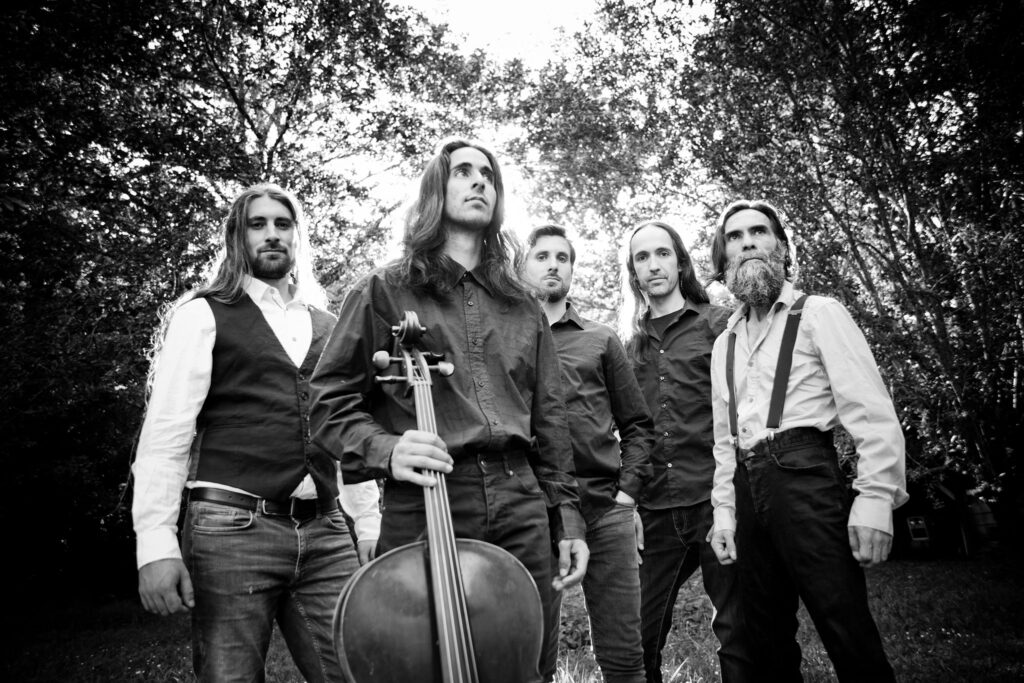
Cellist Priam plays a prominent role in your sound. How did the combination of metal and cello come about? At times the cello takes on a leading role; at others it functions rhythmically, almost percussively. How are these arrangements developed, and how do you integrate them into metal structures? What does the cello add that guitars alone cannot achieve?
Priam wanted to join a metal band because that’s a style he listens to and enjoys a lot. As a classical conservatory player, he also really felt the need to step away from some form of rigidity, aiming for more musical freedom. He wanted to open his horizons, experimenting and bringing his classical knowledge into a different kind of musical creation.
And it’s a great fit! The cello is able to bring new tones and feelings in our songwriting: melancholy on some parts, anger or epicness on others, using all the different techniques of the instrument, like staccato, spiccato… etc.
Like any other member, Priam is free to bring and create his own parts. In the end, our goal is to create a cohesive ensemble sound, where everyone finds its own place.
Your lyrics portray a cold and merciless worldview. Are they personal, societal, existential… or a combination of these?
The first songs we played with Horion were from an aborted Tattva EP from Jej, so 4 songs with lyrics were ready to play. Monarque is one of them. Lyrics have been driven by the social drama period named “ Covid-19”. Just his point of view and feelings from someone forced to live with a lockdown, and people around getting mad day after day.
The power of fear, oppression and lies, and the consequence of sheep becoming way more dangerous than wolves. Give them a merciless shepherd and you’ll obtain a dramatic situation.
Of course now it can sound generic and a bit “cliché” but nobody has forgotten this period. Scars are real, minds and habits are obviously different and young people are dumber than ever. And they’re not guilty of that, that’s just how the elite drive the world and so we dive into their nightmares.
You switch between French and English, and I must say that the French language truly adds something special. Is language primarily a conceptual choice for you, or also a musical instrument? How does this interplay affect the emotional impact?
Indeed, language switches all the time: some songs are full English, other ones full French…and others are a blend of both!French has the advantage of being more emotional, while the English allows the vocals to be more percussive or rhythmic. Lyrics are written to fit depending on the parts, kind of like an instrument will do. Efficiency first. The voice has to be a part of the songwriting. It comes at the end of a song creation, we never write music from lyrics.
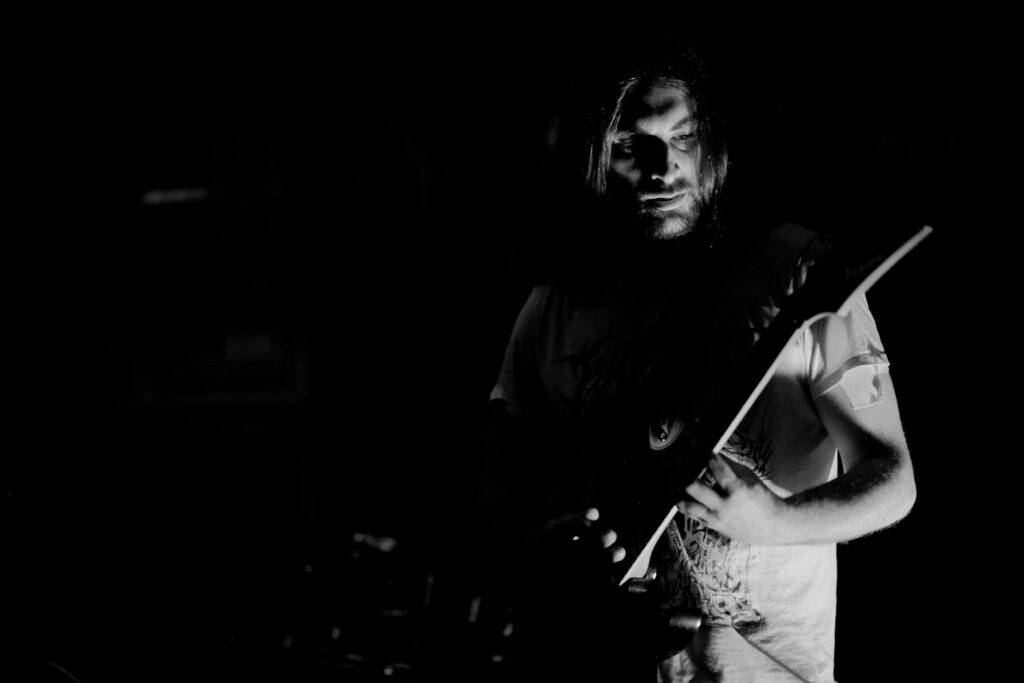
“Doom” sounds raw and vivid, almost like a live recording. Was that a conscious choice? How did the recording process unfold? You handled the production yourselves. What challenges and freedoms did that bring?
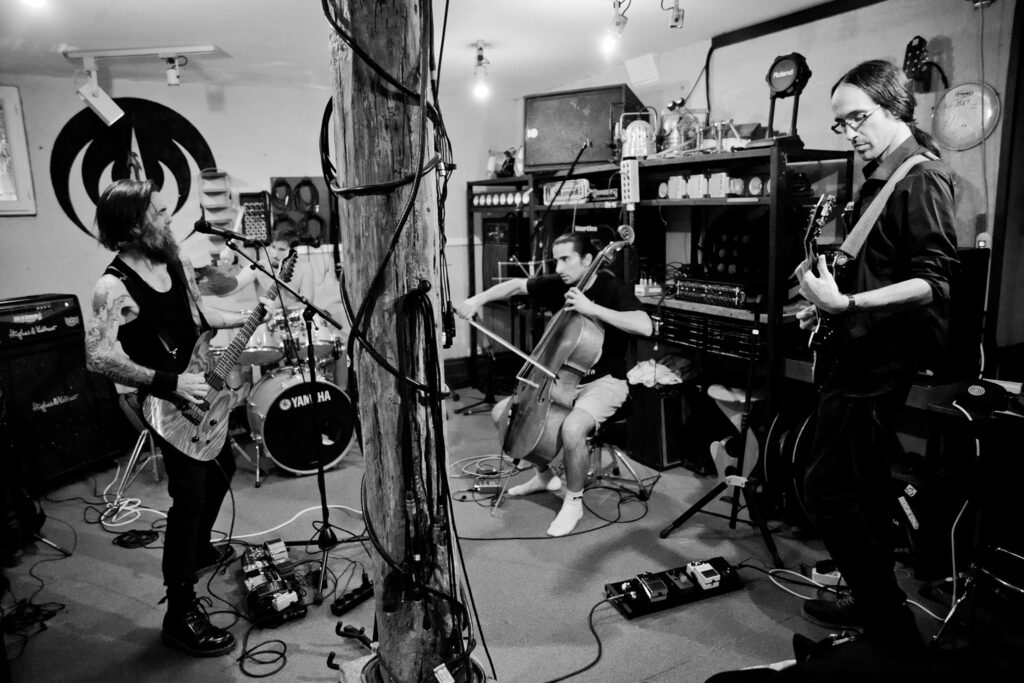
We wanted to make a quality recording, while doing the most by ourselves. We are lucky to know a very nice guy, Jeff, who allows us to rehearse in his private room in his house.
Horion was born there, and doing the recordings (except drums and cello) in this room was symbolic and important to us. We are also thankful to people who helped, lending us some good microphones to record the cello for example.
Our guitarist Jej mixed the record, then we sent it to Notos Productions for mastering. Always better to master with a professional studio. It was a great challenge, a lot of time and effort, research, success and failures to obtain a result able to bring satisfaction to everyone.
The artwork by Bram Bruyneel is intriguing and enigmatic: a shepherd, sheep, and a wolf. It feels calm, yet somehow ominous because of the eagle. There seems to be a great deal of symbolism embedded within it. What is the meaning behind the cover art, and how important is visual presentation to your music?
The artwork is very symbolic, and Bram perfectly understood and embraced our vision, huge thanks to him!
The idea behind this artwork can be summarized like this: are you sure you can trust everyone about a fact, a statement or an opinion, when gruesome people enjoy following like sheep and are ready to sell their souls for the same damned elite? Disconnected elite who decide everyday what is good or bad for you, when you’re allowed to breathe… etc.
The shepherd has the lead, and vultures are not so far to delight themselves with remains of the weakest ones. A wolf among sheep isn’t necessarily a threat. He’s different, but you’re not forced to see him as a curse. He’s a part of us and of our world.
Maybe you’ll find further meaning hidden in the lyrics…
On your social media, I see amazing footage of live performances. Do you see yourselves more as a live band than a studio project? And how does this complex, layered music translate to the stage?
When we started to play together, the goal was simple: playing live. It’s impossible to progress without any recording, but we enjoy playing live in front of people a lot, even more when our music isn’t the most appealing around here. We live near the ocean, with a strong surf attitude you know!
Every live show is a lot of work, we rehearse all together every week and practice a lot at home too. Some parts are fast, physically not that simple, and you have to deliver something solid and consistent until the last second of a show.Even if our music can be seen as dark for some people here, we believe it’s important to hit them in the chest and show that singularity can bring different emotions through a live set.
The EP is a wonderful introduction to Horion, but I am eager for more. Can we expect new material in the future? And what musical direction would you like to explore further?
We are on our way. We already have enough material for more, but we first need to promote this new EP, make more shows and earn money, to allow us to see bigger for our next release. We really want to improve the production and avoid doing another EP. So time and investment will be keys. Maybe we’ll start recording some demos at the end of the year. New compositions will be more ambitious, as we’re always looking to sharpen our identity and vision. Be sure we’ll strike loud with a melodic and singular approach.
Are there any final words for the readers of Merg & Been Magazine?
We are thankful for your interest and time, you seem very passionate and it’s a pleasure to answer such quality questions. To everyone reading these lines, feel free to listen and give us your thoughts about our music. And don’t forget to spread the word!
Greetings from France to you Floris, and all Merg & Been Magazine readers.