

To what extent do you see your current practice as a continuation of your earlier work, and where do you identify clear points of rupture?
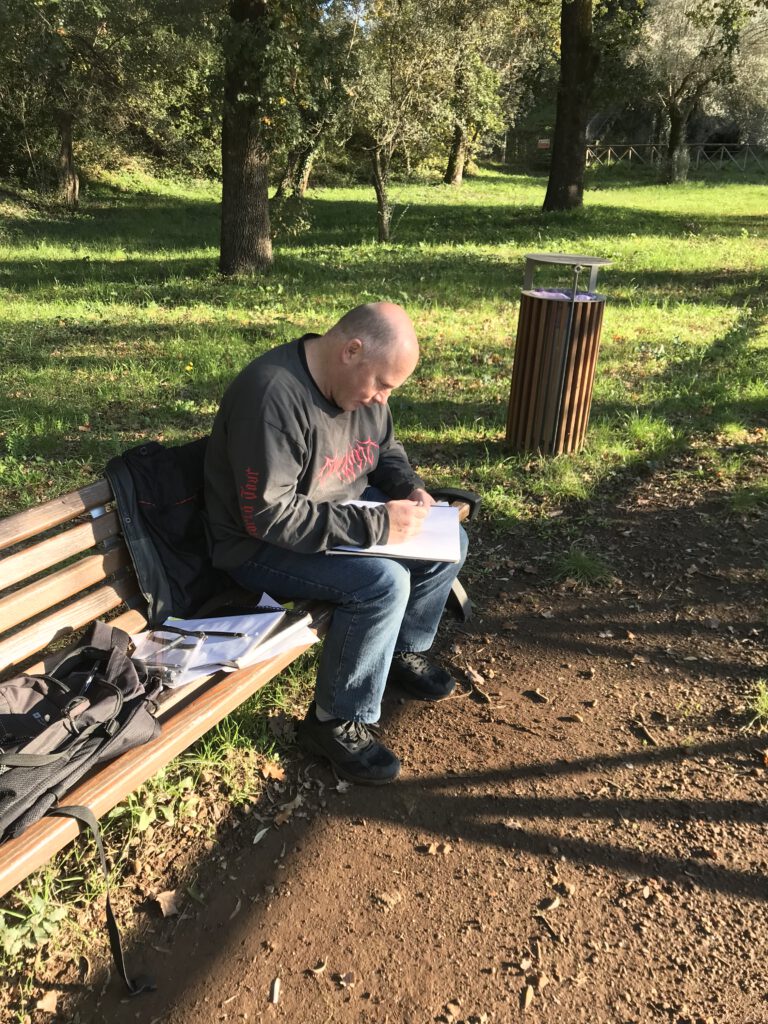
Continuing with my current practice is driven by the fact that computers deliberately challenge my comfort. They create obstacles every time I try to save a file or perform a task. The laptop constantly wants to do something else and refuses to listen to my commands. As a result, I find that working by hand to create logos gives me complete control over every movement of my pen; my pen follows my intentions precisely. Sometimes it doesn’t click, but I set that aside and focus on multiple assignments simultaneously—something I wouldn’t be able to do on a tablet. When I receive a brief with various examples, I print each one along with the accompanying text to have everything in front of me in one place.
Working on multiple screens would only distract me or cause me to lose focus. The key point is that I am unlikely to start working digitally on a computer. I also view artificial intelligence as a clear point of rupture; it might help me phrase emails clearly and make them more pleasant to read, but I don’t believe it can truly capture my thoughts and translate them into tangible, authentic expressions.
How has digitalization influenced your process, and which elements of craftsmanship remain indispensable to you?
Digitalisation is something I delegate to a graphic designer when delivering final commissioned work. Attempting to digitalisemyself was too time-consuming, often resulted in unsatisfactory or lost files, and left me frustrated. As a result, I chose to work manually, where I have the best control over my craft. I collaborate with external graphic designers, primarily Denis Larhubarbe from Mauritius, who corrects imperfections when working with demanding clients.
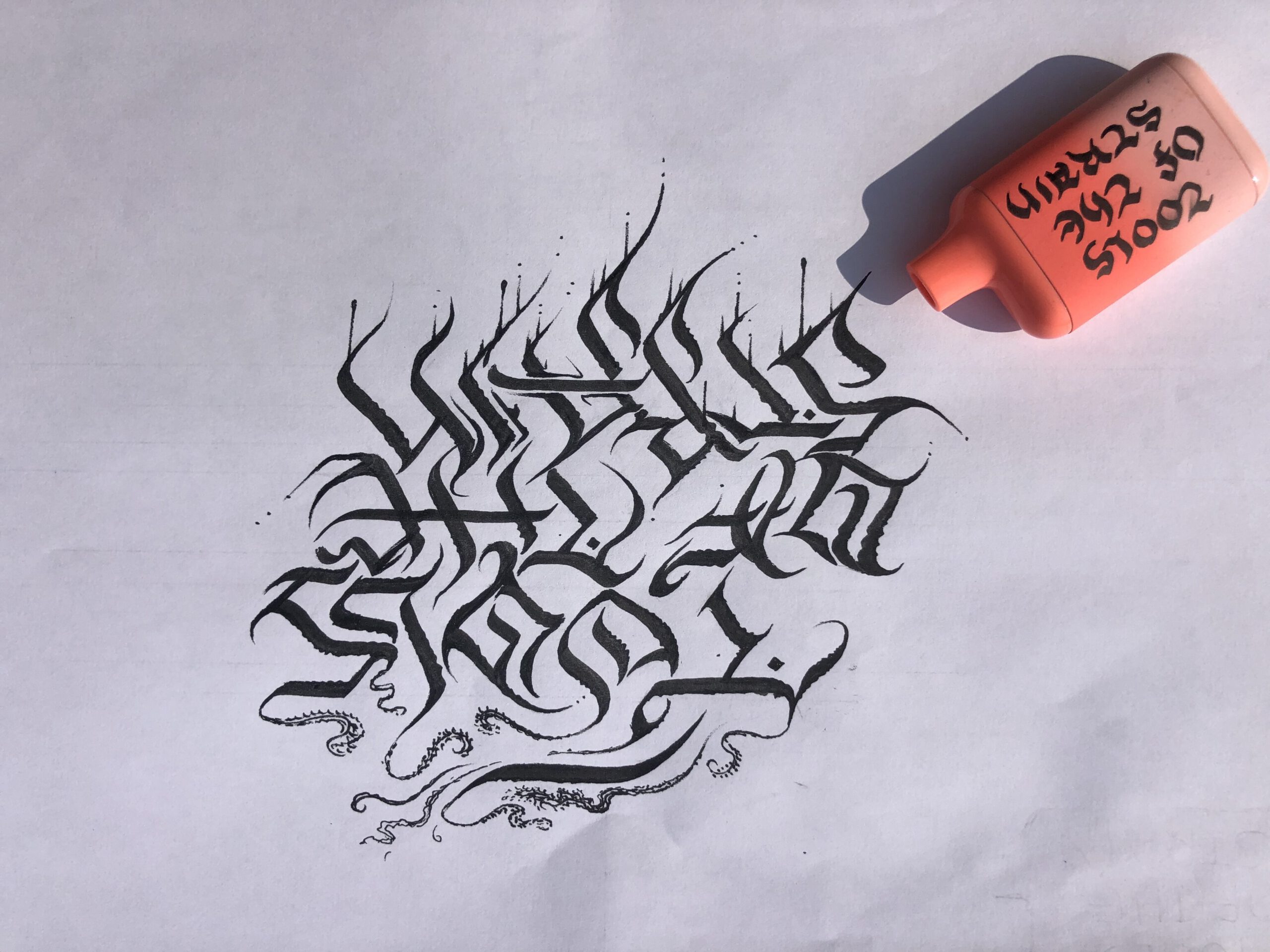
This collaboration is crucial, allowing me to sketch with pencils to achieve precise shapes, scan ink sketches, and use a light pad to perfect symmetry and flow. I rely on pencil work before inking for the best lines and finish by photocopying the final bases for different effects. These skills are integral to my craft and will always remain indispensable.
Your work is increasingly presented independently of music. Does this shift alter the meaning or autonomy of the image?
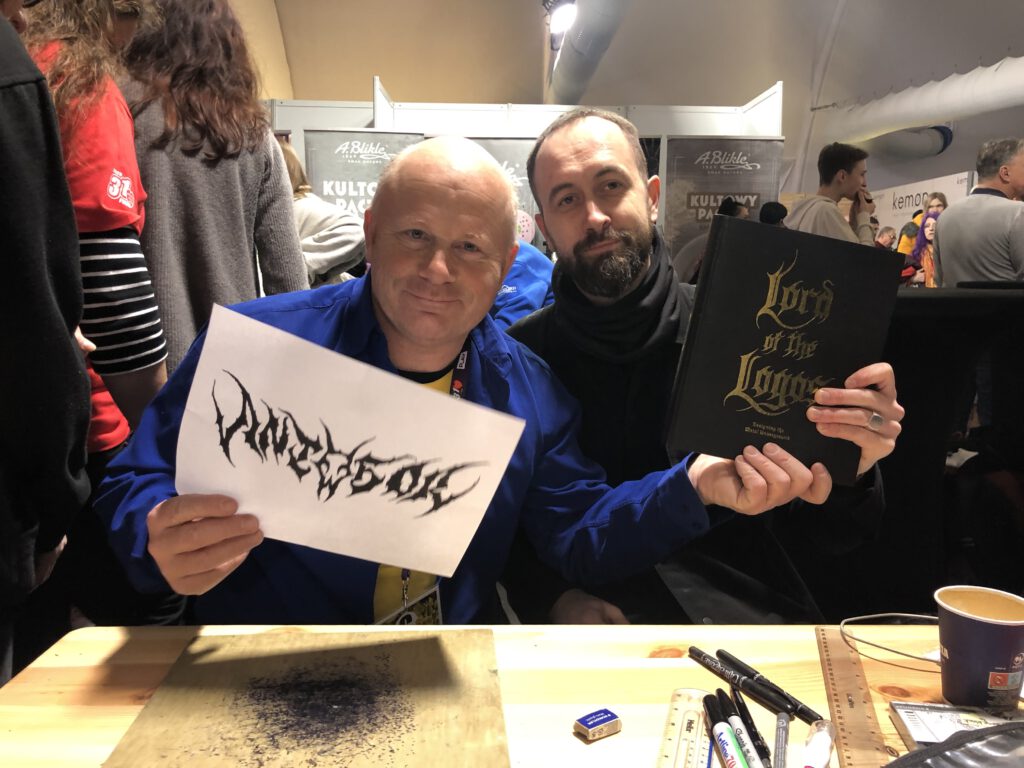
My work is indeed increasingly independent of music, a shift reflected in the clients I attract. Beyond musical projects, I’ve designed for brands like CrossFit and Jim Companies that maintain a bold, heavy-metal-inspiredvisual identity.
Companies such as “Methods to the Madness,” “Omnia,” and “Live Apparent” want their brands to stand out, so I create designs that incorporate elements of heavy metal logos—like black metal and death metal—adapted for non-musical contexts. Interestingly, more musicians are venturing into clothing lines, blogs, and even political or historical sites, where metal-inspired logos seem like a perfect fit. It’s fascinating to see how this aesthetic continues to evolve and find new, unexpected applications.
How do you envision the future of logo design in an era of rapid image consumption and algorithm-driven aesthetics?
I believe that resistance comes from a small but fierce group of artists who refuse to surrender to the artificial intelligence invasion. These resilient creators stand firm for handcrafted design, supported by a handful of dedicated clients who crave authentic logos and genuine craftsmanship. In contrast, many young, instant-gratification seekers—like the so-called ‘kids on the block’—turn to AI because it offers quick results. This creates a divide: those who value real artistry versus those chasing instant images. Artists like Czech creator Vojtech Moonroot, Chris Moyen, Sickness 666, Hans Trasid, David Glomba, and Italian Raoul Mazzero (View from the Coffin) persevere in their craftsmanship, forming a resilient pocket of resistance.
Meanwhile, AI-generated art is becoming cheaper and faster—a natural response to our rapidly evolving visual culture driven by algorithms. An emerging trend, called quiet hiring, reflects this shift. It’s like sneaking into your crush’s social media DMs—clients identify talent gaps without directly contacting designers. Instead, they post publicly, asking for cheap logo designs, then quietly reach out to less qualified artists, often bypassing traditional application systems. This leads to a chaotic mess: unresponsive clients, ghosted designers, and abandoned sketches.
Many creatives have experienced this firsthand. They get messages like, “Can you do us a logo?” sent via social media, only to be ignored after initial contact. Clients want designers to flood them with ideas but rarely follow up—almost like someone showing everything on Tinder and expecting others to take the lead.
But this isn’t the end of the game. It’s evolution. Quiet hiring rewards visibility, relationships, and proof—not resumes or degrees. Winning designers anticipate this shift by building credibility publicly—posting reels on Instagram, showcasing their expertise, and creating familiarity with decision-makers before they need them. By subtly positioning themselves as solutions to future problems, they become unforgettable once a client decides they need a designer.
If you’re not actively making that list, you become invisible. In this environment, quiet hiring is not about improvement but about being strategic. The future belongs to those who build their presence early, craft their reputation, and stay ahead of the curve.
Do you see a place for your work within institutional contexts such as museums, academia, or archives—and what would that inclusion ideally signify?
I clearly see a promising place for my work within institutional settings like museum academia or archives, and I am actively working to make this happen, aiming for March 21. I will be honored with the Universal Genius Prize for my contributions at the Museum of Science and Technology in Milan. This connection aligns with the idea of quiet hiring—viewing current circumstances as a preview of the future, and anticipating people’s needs before they even voice them. Larry Ellison’s words—”See things in the present as they would be in the future”—resonate deeply with me; they should immediately strike a chord and make perfect sense.
This is not something I will wait around for. So far, I’ve reached out to various museums, but responses have been limited to polite rejections like, “This is not something we are catering for,” or, “We’re not looking into that right now.” Despite this, my work has already been showcased during the “Goth: Designing Darkness” exhibition at the Design Museum in Den Bosch, Netherlands, from October 2021 to April 2022, and during “Tod Und Teufel” at the Kunstpalast in several German cities, including Düsseldorf.
Achieving inclusion in this context would mark a significant breakthrough in how my work is perceived, serving as recognition not only within the Metal scene but also in the broader cultural landscape. I am fully committed to making this a reality. To do so, I must adopt a more strategic approach—identifying, anticipating, and addressing the needs of potential museums, galleries, and academic institutions before they even articulate them. Ultimately, success stems from persistent failure—embracing setbacks without losing enthusiasm.
Sometimes, it’s necessary to take the lead proactively, rather than waiting for others to do so. If many artists submit a few sketches, I will submit hundreds. This approach, often called the method of numbers, is designed to capture attention and overwhelm clients. However, standing out requires not just volume but also brilliance—reading people’s minds and understanding their needs before they express them. In a humorous note, if you want to have a mortgage, you must first demonstrate that you don’t need one.
If your work were to be studied a hundred years from now, what do you hope it would be read as: a style, a historical document, or a form of visual ritual language?
If my work were to be studied a hundred years from now, I believe it would be seen more as a style than a historical document or visual ritual language. The reason is that most of my local designs are intended to be visually striking—designed to catch the eye immediately, be affordable, be instantly recognisable, and therefore be memorable.
Take logos like Metallica, Motörhead, AC/DC, Lynyrd Skynyrd, or brands like Coca-Cola, Kraft, Woolmark, Kellogg’s, the Ukrainian trident, Grammarly, and MHP—these designs stand out instantly, and that’s what makes them successful. In a world where attention spans are incredibly short and getting shorter, we call such brands ‘scroll blockers’—they make you stop scrolling the moment you see them. A hundred years from now, I hope only images or songs that are catchy and serve as effective visual ‘blockers’ will be studied, because they’re so powerful—they instantly stop you from zipping from one thing to another.
These are showstoppers—symbols of efficiency and immediate impact. That’s the essence I aim for.
What are the future plans and any last words?
17 th of January, Pamiec Krwi – Blood and Memory, Konduktorownia, Czestochowa, Poland
22nd of January, Pulse Film Festival, Antwerp
24th of January, Artist of the Art History international prize, curated and awarded by Fondazione Effetto Arte, at Palazzo Borghese, Florence, Italy
21st of March, Universal Genius – Tribute to Leonardo Da Vinci, curated and awarded by Fondazione Effetto Arte, at the Museum of Science and Technology in Milan, Italy
25th of April, Droned to be Doomed Night with Nihili Locus and In Lugubre Tenebris, BlahBlah, Via Po 21, 10124, Turin, Italy
1st and 2nd of May, Church of Crow Doom Festival, Chiesa Sconsacrata di Pinerolo, Via San Giuseppe, Torino
August 7th -8th, Hellsinki Metal Festival, Finland
August 27th, 28th & 29th , Drums of War Festival, at Atlantic Events, (Carrer del Plom 1 – Metro L9 Fira), , in Barcelona, Catalunya, Spain.
Lastly, I warmly invite anyone interested in my services or exploring collaboration opportunities—whether an exhibition or another exciting venture—to reach out to me via email or my website. Please check your spam folder, as my responses often end up there. Also, please verify your outbox for any undelivered messages. Thank you for your interest; I look forward to connecting with you!