
From the shadow-drenched outskirts of Chile to the ancient streets of Maastricht, a solitary storm has taken shape, unyielding, intimate, and fiercely uncompromising. Necrobeast channels raw Black Metal through isolation, displacement, and an unfiltered obsession with the abyss. In this interview, we speak with the mind behind the project about roots and relocation, creative solitude, and how a new homeland has reshaped the sound of his personal descent into darkness.
This year, the debut demo of Necrobeast was reissued through Brutal Insanity Records. How was the collaboration, and how have people responded to the re-release?
2025 was the 20th anniversary of the recording of the demo. Roy from Brutal Insanity Records believed in the project and its legacy, and he provided a platform to bring the demo back to life. The collaboration with Roy was great. He released 50 copies and handled all production. He was in charge of the booklet layout and the tape print, and I think he did a great job.
The tape not only looks amazing, but since we didn’t want to just reissue the same four songs, I added a hidden track. A roughtrack version of ‘Blood Gods’, a killer anthem heralding the upcoming full-length. The demo was received pretty well. It was great to see that the songs are as powerful as 20 years ago. They stood the test of time, which in this day and age isn’t a small feat.
Originally, the demo format was the CD; however, given that cult analogue sound, it fit perfectly on tape. I have gotten a lot of emails from old Necrobeast fans, some of them showing me pictures of the original CD-R version, still going strong after all these years. I am glad to see that the black flame still burns! The demo will also be reissued sometime this year by the Chilean label ‘Approaching Conflict’. It will also be on tape. The production will be different. The booklet will be in different colours and have different pictures. Although the art in itself will remain the same, the Iron Baphomet looks straight into your soul. It will include hidden tracks, raw versions of some songs from the album. The songs will be different from the Brutal Insanity version.
At this point, we can no longer call Necrobeast a Chilean band, as you’ve been living in the picturesque city of Maastricht for several years now. To what extent has the Burgundian atmosphere of that city influenced the writing of the upcoming album?
This is a hard question. In many ways, I do believe that the Necrobeast’s sound has not changed much since our 2005 demo ‘El despertar de la Necrobestia’. It is still clearly a black thrash metal album with the same raw sound and aggression that I started with. However, the compositional level, both lyrically and musically, has advanced. And that has to do with my surroundings. It is true, I have been away from the homeland for a long time. 12 years now, with a long part of that being in Sweden (Uppsala) and the Netherlands (Maastricht).
Interestingly enough, I grew up in the south of Chile, in Valdivia. And Valdivia, Uppsala, and Maastricht are very similar to each other. In terms of nature, surroundings, and weather. Like in Maastricht, in Valdivia it rains a lot (about 300 days a year). It is dark, cold, and windy in winter, surrounded by forests with tall trees, like in Uppsala. Our winters are long and dark, and the lack of sunlight is prevalent, just like in Sweden and the Netherlands. Maybe the most distinct element in Chile (besides the food) is the volcanoes and the big mountains that surround us; still, I feel like these places, though clearly different in some ways, hold a familiarity that inspires my music.
If anything, Maastricht and Limburg have reinforced my vision for Necrobeast. In the area, we currently have great bands like Necromantic Worship, Witchfukker, Galghe, Wurgilnõ, among others, that have a very clear identity and distinct sound. They evoke these primal feelings of aggression and introspection. Necrobeast’s music also taps into these feelings. So, although the styles might be different, they all seem to manifest sides of the same spirit.
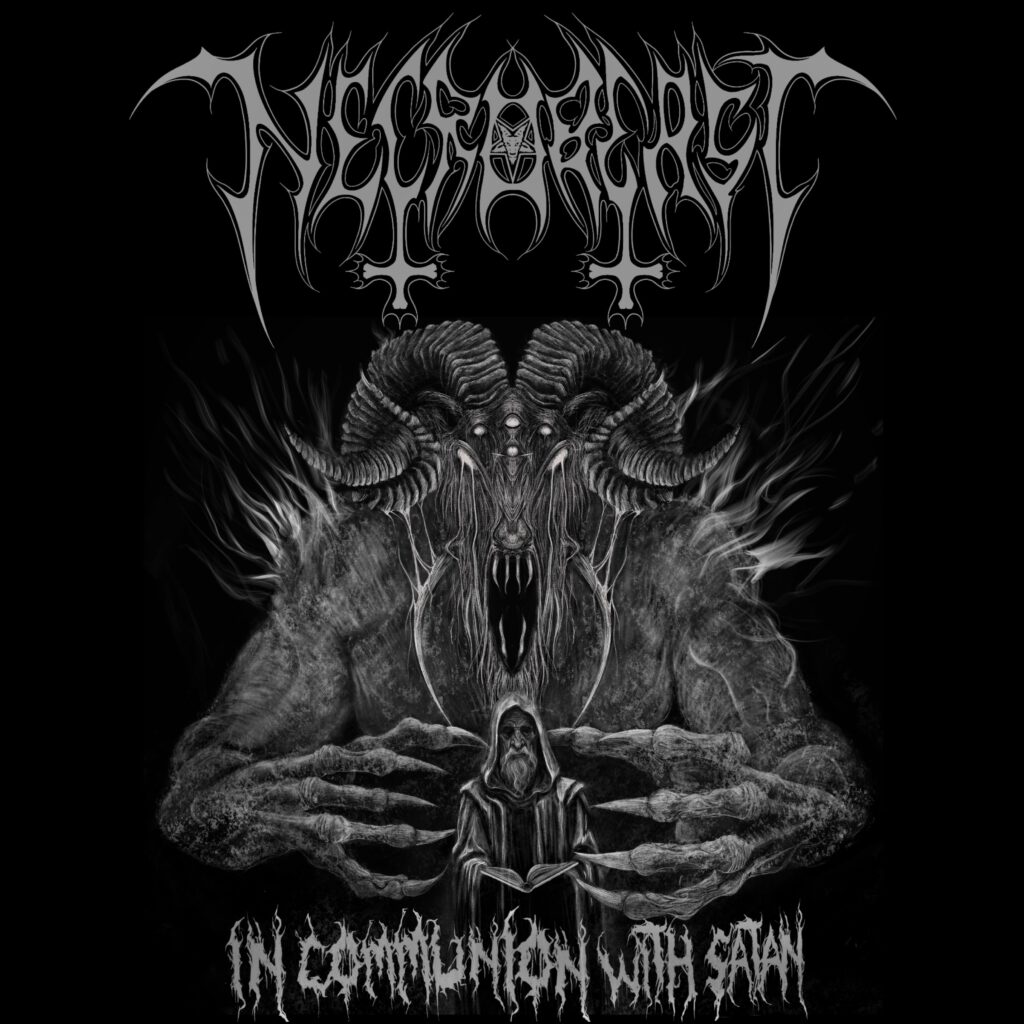
In ‘Iron Baphomet’, you can see the influences of Maastricht and Uppsala. The first single, ‘In Communion with Satan’, talks about the ‘brujos’. These powerful entities that, before ascending, were humans who needed to go celebrate rituals of death and blood, ultimately selling their souls to Satan to gain powers. In Limburg, you have the Bokkenridjers, which are a similar figure. In the song ‘Jakten’ (The Hunt), the presence of rain and nature is prevalent throughout. In Sweden and other Germanic cultures, you have ‘the wild hunt’, this procession of spirits that people could see riding in the skies, presumably describing the northern lights. In the south of Chile, we have the aurora australis, and the myths of the Trempulcahue, the four mythical Wales that took your soul to the volcano in a celestial procession that one could also see in the skies if you paid enough attention.
As a one-man band, it’s not always easy to write an entire album. What was the writing process like for you?
I like to joke that ‘Iron Baphomet’ took twenty years. In a sense, it is true; however, I feel that the album took as long as it needed to. I started writing songs more consistently after joining Morphetik (a Swedish Thrash Metal band). In Morphetik, it was mostly a collaborative process: I wrote the guitar riffs of several songs, and everyone pitched in, adding other instruments and arranging the song. Necrobeast is a whole different game; I need to write all the instruments and the lyrics, which is a massive change. Luckily, Morphetik gave me the experience to know where to start with a song. I see Necrobeast as a riff-based band. So the first thing I do is write the guitars, everything else follows.
I have a very specific idea of how black/thrash should sound. I like that one can identify sections of the songs that are either clearly thrash or black metal. I feel like the interesting part is how to make the connection between riffs of two very different kinds of genres seamless. So you can feel like, although they sound quite different, the song makes sense and isn’t just a mismatch of things thrown together. This also adds variations within the album. It is very easy to fall into the pitfall of sounding “the same” in every song. There are many albums nowadays that feel like just one long song cut into different parts. The “art” is to keep oneself within the style without being repetitive, and I think I have done that.
The lyrics come from different sources of inspiration. ‘Iron Baphomet’ explores the occult forces that shape our reality. Call it Magic, Destiny, or a specific entity, throughout history, there has always been a recurring return to something we cannot see. I draw from that collective wellspring of wisdom to give voice to the message of each song. However, the central themes will change from album to album. At the moment, I am working on a new album that will revolve around the concepts of time and death. Time is seen as an entity that carries us back inexorably to the void.
The influences of Necrobeast are largely rooted in the 1980s. How important is that musical era to you?
It is paramount. I grew up with that music and sound. In many ways, I think that how I conceive thrash metal is inexorably linked to the 80s sound. I do not write to “sound 80s”; this is just the way things are.
One example is the “crispness” of the voice. When listening to ‘In Communion with Satan’ or ‘Promethean Flame’, you can understand (for the most part) what is said. If you listen to other black thrash bands, you will notice that the voice is typically very difficult to understand. Although the instruments are intelligible, the voice is murky. One can have many explanations for it. I tend to think of it as this early 90s “In the Nightside Eclipse” sound. You know, where the voice seemed to be coming from the back of a cave. Sound-wise, it feels like the voice track is “behind” the other tracks. I personally think that when you play thrash metal, the voice needs to stand out. Think of Slayer and the rest of the Bay Area, go to Europe and look at the German Trinity. Granted, their earlier works, demos and eps, and EPs had this style of voice, but by their first full-length albums, the voice was preeminent and clear. Thrash metal songs have always carried a message, and that is why I am a stickler for the voice when mixing and mastering.
Besides the ‘80s influences, there are also clear South American elements to be heard in your music. How consciously do you try to preserve that regional sound now that you live in Europe?
As I said in the previous question, I have a very clear idea and vision as to what counts as a black thrash metal song. In this understanding, the South American sound is ingrained. I grew up with early Sepultura, Pentagram Chile, Atomic Aggressor, Death Yell, Sarcofago, Torturer, it is unsurprising that the way that I understand black thrash is pervaded by the sound that these bands forged. I do not consciously try to preserve the sound, nor is there any particular goal to do so. In the same way, Necrobeast’s sound is also highly influenced by Japanese thrash metal. Bands like Sabbat and Abigail were always with me when writing.
I think the blend of South American and Japanese Black Thrash is highly appreciated here in Europe. It gives another layer to the style, an interesting spin. That underlying punk vibe and those brutal drums help to break the typical patterns of the style. Personally, this characteristic helps me blend the styles. As I mentioned, I see a Black Thrash song not as a mashup of styles but as a clear landscape, with a section where black metal is present and another where thrash metal is. My idea is that anyone can dissect a Necrobeast song and clearly identify certain sections as belonging to a pure version of black metal and others to pure thrash. However, there is a red thread that ties these different riffs together, and that is where the South American and Japanese influence kicks in.
Live performances are essential to the identity of many extreme metal bands. Are there plans to bring Necrobeast to the stage, and if so, with which musicians?
Yes, there are. ‘Iron Baphomet’ will be released in May this year, and my plan is to play live as much as possible. As a one-man band, there are extra challenges to sort out if I want this to happen. First and foremost, find live band members to play with. Luckily, I have several friends who are interested in playing live when the time comes. The second challenge is to find a rehearsal space. And lastly, to deal with the bookings. It is all very costly and time-consuming, but ultimately it is worth every cent. When things are meant to happen, such as Necrobeast, they fall into place. The Iron Baphomet will open the path to illumination.
At the moment, it is not possible because I am not in Maastricht for work, and we will start recording our third album with Morphetik. Despite wanting to play live as much as possible, I am not in a rush. Things beyond my control might mess with the timeline, so I need to stay flexible. I trust that, in the meantime, the music of the Necrobeast keeps the flame alive.
In terms of production you often lean toward a raw, analog sound. Is this a philosophical choice, an aesthetic one, or simply what fits the song best?
That kind of sound fits the vision that I have for both the song and the band. In a similar vein, the end sound is the real-world version of what it sounds like in my mind. I do think that modern versions of the genre might fall into overproduction. They sacrifice character for a semblance of “good sound”. I do not advocate bands sounding like shit on purpose. In this day and age, there is no excuse to sound poorly. There are many affordable or free tools that can help you achieve high-quality sound. This is different from being overly polished or overproduced. That kind of sound simply takes away the song’s weight and feeling. It is no mystery that after one writes a song, the production phase is crucial to shape whatever spirit the song has. I believe certain decisions can kill it, while others can strengthen it. For Necrobeast, the raw analogue sound is the latter.
Can you tell us something about the themes and concepts behind the new album? Are there recurring symbols, stories, or influences that play a central role?
‘Iron Baphomet’ is an 8-song full-length. Each song explores different aspects of human reality. The stories of powerful entities that we believe we can control or enter into agreements with to obtain earthly power. Ultimately, it is this power that historically pushed the human race to extinction. The overarching topic is the Great Unknown and how we, humans, try to control it or profit from it. The songs’ inspiration is usually rooted in myths and poetry.
The recurrent symbol of the band is the figure of the ‘Iron Baphomet’. You can see it on almost all the covers for Necrobeast’s releases (Demo, first single, and soon the album cover). The Iron Baphomet is meant to represent the occult aspect of reality: power, desire, knowledge, the myths we tell each other to explain the world.
What do you think is the biggest misconception people have about old school black/death metal, and how does Necrobeast either challenge or reinforce that perception?
I do not seek to reinforce or challenge anything style-wise. I do not know what misconceptions people might harbour, aside from the fact that the sound quality typically paired up with these styles isn’t always the best. This might be either a technical issue or a post-production decision. I do not know. If you want to push me to give an answer, I think I could say there is no excuse for poor-quality sound anymore. Necrobeast might “challenge” that preconception through the sound’s quality. Still, it is left to the listeners to decide whether my challenge succeeds.
You operate completely independently as a one-man band. Are there aspects where you sometimes wish you did have a full lineup – or do you thrive on having complete creative control?
Well, a one-man band has its perks. It streamlines creative control over music and decisions about the band’s aesthetics, social media, distribution outlets, labels, etc. It speeds up any process in terms of creativity and exposure. However, running a band at a semi-professional level (if any) is quite costly in both time and money. Merch, streaming services, equipment, studio time, etc., are financially draining. Still, I do not see it as a burden but an investment. Necrobeast is a lifetime project, and I am glad to put my resources into it.
Another aspect that suffers when you have a one-man band is playing live. The obvious challenge is finding people who can and want to play your songs, and then finding a way to meet regularly for rehearsals. Then, of course, comes the booking. Granted, one can add it to the financial burden and pay a booker. However, sometimes the fees are too high for me to cover, with little to show for it. After Iron Baphomet is out, my next challenge is to figure out the live playing aspect. This is something that I want to do badly. It will be difficult, but I will find a way.
What does your ideal environment for music look like? Do you work structured way, or do you rely more on spontaneous inspiration?
I initially relied on spontaneous inspiration. The demo was the product of that, and a big part of the album also. However, I have now recorded an EP that I hope will be released next year. The EP was the result of conscious, structured work. I realise that my inspiration outbursts are short-lived, and if I wait for the next one, it could be another 20 years before I make another album.
I am trying to devise a habit of writing and composing that will “produce” inspiration. Of course, you cannot produce it per se. That is the whole point. However, I do believe that we can force ourselves to find it. Know where and what to look for: little inspiration triggers. If I can find it, I can use it regularly to write songs. How am I supposed to find it? That is the question I am trying to answer. At the moment, structuring time to listen to music/read relevant literature, and leaving daily hours for practice/play, has worked out pretty well. The EP is proof that it is possible to find a middle way between spontaneous inspiration and methodical work.
What is currently your biggest source of inspiration outside of music – whether literature, film, history, or personal experiences?
Literature, mostly. In general, I read a lot of literature, which helps spark my imagination. I enjoy a variety of genres, and I am interested in learning to write my thoughts in a way that evokes emotion. Poetry is very useful for that, but also science fiction. Many of the songs’ ideas and song titles come from stories I have read throughout my life. Another source of inspiration is nature. Describing the landscape around me, or the one I grew up in, helps shape the atmosphere I aim to project through the musical arrangements. I think that black metal and nature are intrinsically related. A big part of the 1st and 2nd waves of black metal relied heavily on Nordic nature, either to provide atmosphere or to replace the divine element, shifting the focus from blasphemy to nature worship. Necrobeast’s lyrics speak of nature as a force that roots our identity and provides the setup where everything unfolds.
How do you view the current state of the underground scene, both in South America and in Europe? Do you notice major differences in mentality, sound or support?
I think that the scene in South America and Europe is still going strong. The main difference I see so far is that South America produces more extreme metal than Europe, for the most part. A heavy metal revival in Europe has injected the genre with strength and vitality. In South America, death and thrash still reign supreme. I wouldn’t say there is much difference in sound quality. Even when comparing bands of the same style, it is sometimes impossible to tell whether one is European or South American. Take, for example, Unaussprechlichen Kulten (Chile) and Dead Congregation (Greece) or Violator (Brazil) and Traitor (Germany); someone would be hardly pressed to figure out the difference by sound quality alone.
There is this idea that because Europe is where “everything happens”, metalheads are a bit used to seeing all the bands, hence they are not enthusiastic, whilst in South America, even bands that are not particularly big can cause major fervour in the audience. I do not know how true that is, but I must say that in Europe, certain countries are more “passive” than others. By this I mean either do not mosh or headbang on stage, but silently watch the show with their arms crossed, applauding and cheering only when the song ends. I have seen that many times. Still, people buy merch, go to concerts, listen to your music. And that seems to be fine with me.
If you had to choose one Necrobeast track that best represents what the project stands for, which would it be and why?
When I finish recording Iron Baphomet, and the time came to showcase Necrobeast to the world I asked this question myself. I chose ‘In Communion with Satan’ as the first single exactly because I thought that this song was Necrobeast in its purest form. It is brutal, raw, and neckbreaking. I do not claim to reinvent any genre, nor to do anything new or original, I do not care about that. However, I do claim to do justice to the essence of black thrash. I think ‘In Communion with Satan’ does exactly that. Necrobeast will break your neck for the glory of the Iron Baphomet.